ELV requirements: What manufacturers, suppliers and OEMs need to know now
The EU regulation on End-of-Life Vehicles (ELV) aims to gradually increase the use of recycled materials in the automotive industry. A distinction is made between post-industrial recycled material (PIR) from production waste and post-consumer recycled material (PCR) from used products. In the context of ELV, the focus is particularly on PCR from end-of-life vehicles.
The agreed requirements apply to newly type-approved vehicles, i.e. new vehicle models. Existing model series would therefore not need to be retroactively converted.
The following targets are set for plastics in new vehicle models:
- Six years after the ELV Regulation comes into force: 15% PCR (expected from mid-2032)
- Ten years after the ELV Regulation comes into force: 25% PCR (expected from mid-2036)
The recycled content requirement can only be met using post-consumer recycled material (PCR) – not post-industrial recycled material (PIR). In addition, 20% of the requirement (3% from 2032, 5% from 2036) must come from closed-loop recycling of plastic waste from end-of-life vehicles.
Pressure for regulatory action
The ELV Regulation introduces new requirements. Companies must adapt their materials, processes and documentation at an early stage.
Cost and planning pressures
ELV requirements can have an impact on material costs, procurement and development costs.
Supply chain challenges
Material availability, proof of origin and quality requirements increase complexity throughout the supply chain.
Time pressure
Material evaluations, development and approvals should be prepared at an early stage.
Uncertainty regarding certificates and evidence
Reliable information on the origin, quality and composition of materials is becoming increasingly important.
Supply chain complexity
The use of PCR brings with it increased requirements for transparency and documentation.
Get ready for the ELV requirements now
-
The proportion of plastic in vehicles is increasing – and at the same time, the importance of the circular economy and the use of recycled materials is growing.
-
OEMs and suppliers are increasingly exploring how upcoming ELV requirements can be implemented both technically and economically.
-
Regulatory developments, material availability and quality requirements make early preparation a sensible course of action.
-
Those who identify suitable applications and materials at an early stage create a solid foundation for future production solutions
Working closely with our customers, we have already developed effective solutions for PCR components in the automotive industry
100% compliance-focused development
Our solutions are developed with a view to future ELV requirements and relevant quality standards.
Available immediately
Existing material and component designs enable a quick start with suitable applications.
Cost-effective
We consider technical feasibility, material usage and cost-effectiveness as a whole.
Material expertise
Pöppelmann has many years of experience in processing recycled materials – with PIR for over 40 years at Pöppelmann and for over 15 years at K-TECH, and with PCR for around 8 years at Pöppelmann and for around 6 years at K-TECH in the automotive industry.
Technical support
From the initial concept to the final production solution, we support the development process with a practical and application-oriented approach.
Transparent supply chain
We are working with our partners to ensure transparent material flows and reliable documentation.
Already in series production: our PCR references
No test projects – real-world applications that are on the road today.
Design4Recycling
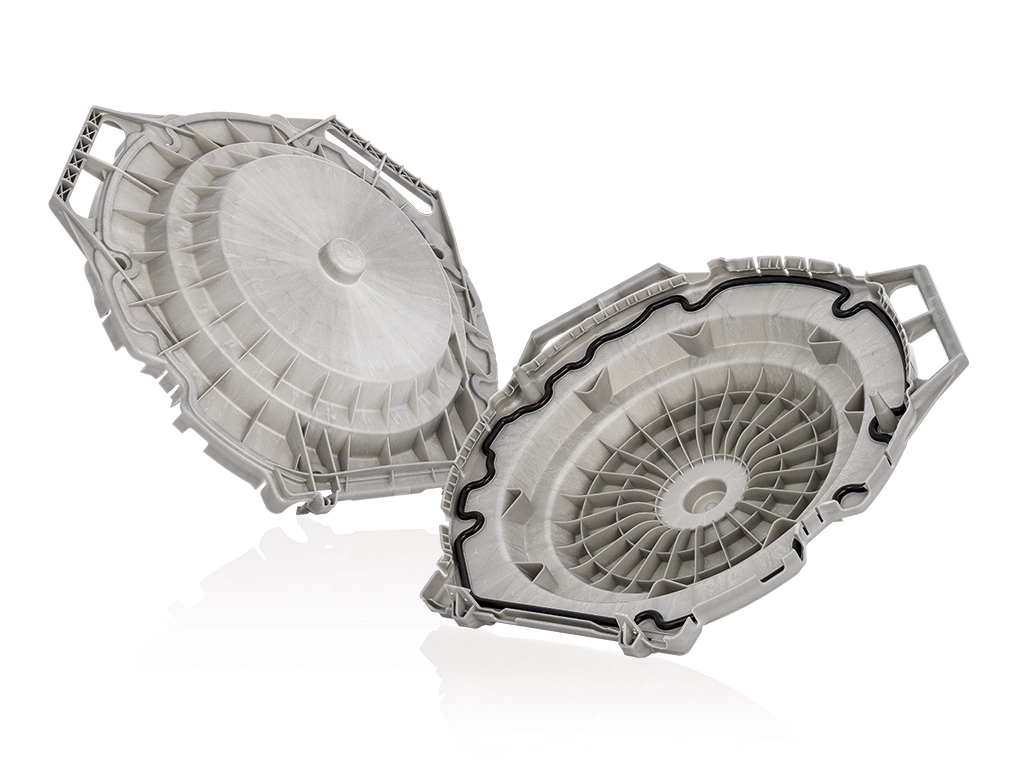
Washing cap
CO2e-Footprint:
-77%
Material:
PP-T20 (PIR und PCR)
Our wash caps follow a closed material cycle system - from production to use to recycling. By using PIR and PCR, we reduce component density and locking force in injection molding. This means noticeably lower CO₂ emissions with optimum functionality. Eco-design makes sustainability visible and measurable.
PCR USE
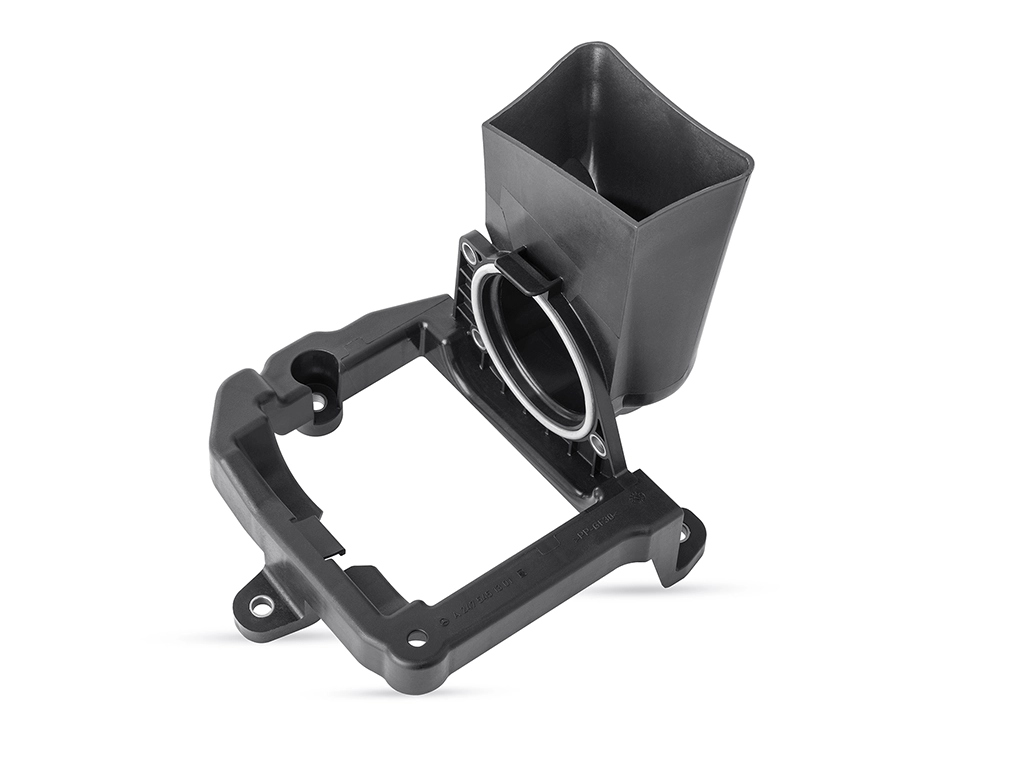
Holder sound generator
CO2e-Footprint:
-46%
Material:
PP GF30 (PCR)
What used to be packaging is now precision automotive components. By using PCR material, we reduce CO₂ emissions by 46% compared to virgin material. Thanks to precise material analyses, tailor-made recipes and strict quality controls, even sophisticated components such as sound generator holders meet all technical standards - with a significantly better environmental footprint.
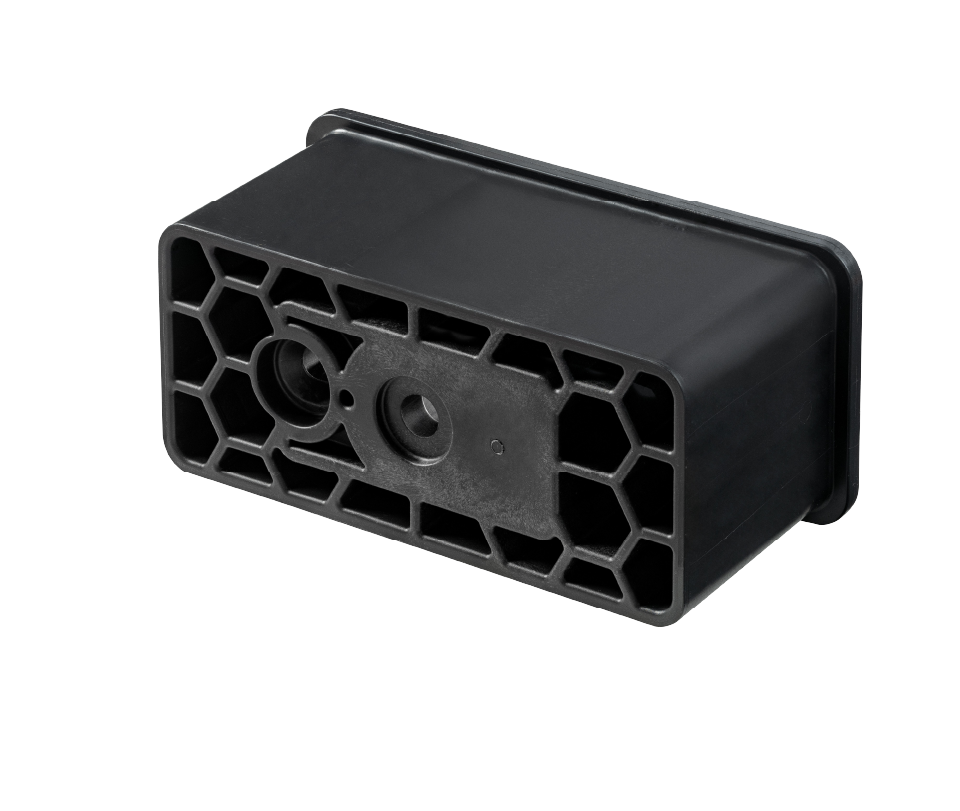
END-OF-LIVE VEHICLE MATERIAL
Add-on console
CO2e-Footprint:
-71%
Material:
PP-EPDM (PCR from old car material)
Our top console is made entirely from recycled plastic from end-of-life vehicles - a real contribution to the circular economy. With 71% less CO₂e compared to new products, we are sending a strong signal for climate protection. At the same time, the console already meets the planned EU requirements for end-of-life vehicles. Sustainability meets future-proofing.

PCR FOR VEHICLE INTERIOR
Holder shaft footwell
CO2e-Footprint:
soon
Material:
Interior PCR
coming soon
For the first time, we are successfully using PCR in series production for interior components. This allows us to significantly reduce greenhouse gas emissions while meeting the strictest quality and safety standards. The materials are emission-safe and meet the highest requirements in terms of feel, appearance and durability. Circular performance is our claim – sustainability as the new standard in the interior.
*CO₂ footprint analysis: cradle-to-Pöppelmann-gate compared with a product made from virgin material
100% closed
Old car circuit
Our add-on console complies with the upcoming end-of-life vehicle regulation
We are setting new standards with our component. The add-on console consists of 100% post-consumer recyclate from end-of-life vehicles, which we process in our own compounding facility. This not only shows how we can close the loop, but also how the automotive industry can drastically improve its CO2 balance. Extensive testing ensures that the components meet the industry's stringent requirements. At the same time, we achieve a saving of 71% of greenhouse gas emissions compared to virgin material.
Supply and future availability of
post-consumer recycled material for the automotive industry
The use of post-consumer recycled material (PCR) in the automotive industry is currently still limited. However, with the planned ELV requirements, the demand for certified recycled material for technical automotive applications is set to rise significantly.
The following key figures for 2022 clearly illustrate the market situation in the EU for post-consumer recycled material (PCR) and highlight the gap between current levels and the planned requirements set out in the draft ELV. Further information on the recycled materials market can be found in our white paper.
54.1 M t
Annual plastic demand in the EU (virgin material and recycled)
13 %
Average PCR share
4.6 %
PCR share in the automotive industry
Current market situation
- Today, the automotive industry primarily uses virgin materials and post-industrial recycled materials (PIR).
- PCR from end-of-life vehicles is currently only available in limited quantities.
- Quality and availability remain key challenges for technical automotive applications at present.
What is changing now
-
The planned ELV requirements will significantly increase the demand for recycled materials.
-
In the long term, recycled content targets of up to 25% are envisaged.
-
There is therefore a significant gap between current market supply and future demand.
The key challenges
-
Consistent material quality
-
Adequate supply
-
Grade-specific collection and processing
-
Certification to automotive standards
-
Increasing demands regarding safety, process stability and documentation
That's what matters now
-
identify suitable components and applications
-
establish stable material flows and supply chains
-
qualify recycled materials for automotive applications
-
design products to incorporate PCR materials at an early stage
TOGETHER.
NOW.
From material strategy to series production: let’s develop your PCR solution together.
FAQ
Which recyclates are available for use in vehicles?
Post-consumer recyclates (PCR) from used products must be used to meet the requirements of the EU Commission's draft End-of-Life Vehicle Regulation (ELV). The main types of PCR available are polypropylene (PP) and polyethylene (PE) from packaging and PET from drinks bottles. Technical plastics are only available to a limited extent.
Which vehicle components can be made from recycled materials?
Various vehicle components made of PCR are conceivable, especially products outside the passenger compartment in the non-visible area. We already have experience with the use of PCR in holders and protective elements.
How does the processing of recyclates compare to virgin material?
The variety of recycled materials is significantly lower than that of virgin material. A PCR is usually a mixture of many different plastic types of one polymer. We specify each recyclate for use in vehicle components and record processing parameters that allow us to simulate the production of the component from the respective recyclate as early as the development phase.
How do products made from recycled materials compare to products made from virgin material?
The variety of plastic types within a PCR also determines the mechanical characteristics of the material and the subsequent component. We determine the mechanical parameters for each PCR, which enable us to design the product to meet the requirements of its requirement profile and the expected load.
What influence does the use of recyclates have on the greenhouse gas emissions of plastic components?
No primary raw materials are required for the production of recycled materials, meaning that these materials generally have a lower product carbon footprint (PCF) than the comparable virgin material. For our products, the PCF of the PCR variant is usually 30% or more lower than the PCF of the comparable virgin material variant.
White paper: From old car to new car.
How you can already meet the planned ELV requirements with recycled materials.
What you can expect in the white paper:
- Insight into the new ELV regulation and its impact on OEMs and suppliers
- Practical best practice examples from the automotive industry
- Solutions for how PCR plastics from end-of-life vehicles can be reused in new parts
- Facts and figures on the recycled material gap and how you can take countermeasures now